
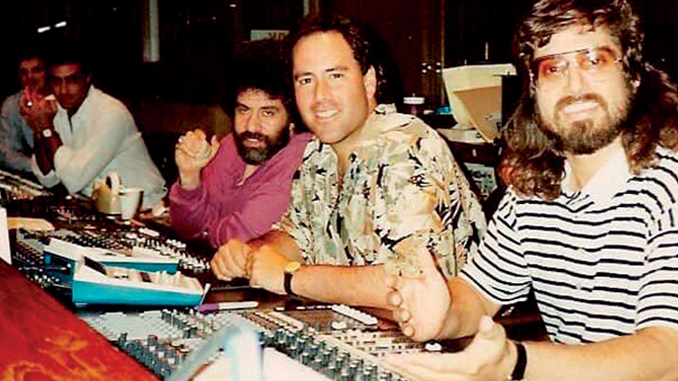
There’s a moment in nearly every great film where the music does something to you before you understand it. A swell that tightens your chest. A silence that makes the next sound hit harder. For more than four decades, Oscar-winning re-recording mixer Steve Maslow, or “Maz,” as he was known to his beloved colleagues, was the man making the creative decisions that helped those moments land — quietly, precisely, and in a dark room most audiences will never see.
Maslow died on April 27 from cancer at the age of 81.
“Steve’s work will continue to reverberate throughout the world for decades to come, said Guild President F. Hudson Miller. “His charm, humor, talent, and friendship will reverberate throughout the hearts and minds of his friends, colleagues, and clients for a lifetime.”
Maslow specialized in mixing dialogue and music, and his work can be heard on more than 200 films — including iconic blockbusters and critically-acclaimed features such as Robert Redford’s “Ordinary People” in 1980, “Speed” in 1994, and “The Great Gatsby” in 2013, among numerous others for esteemed directors including Steven Spielberg, John Carpenter, Baz Luhrmann, and Tim Burton, as well as hit music videos and concert films for Martin Scorsese, Prince, and Neil Young.
For more than half of those, he worked alongside Oscar-winning sound effects re-recording mixer Gregg Landaker, with whom he won three Academy Awards and was nominated for three others (his seventh nomination for the 1984 film “Dune” was shared with Bill Varney, Kevin O’Connell, and Nelson Stoll).
“Our collaboration was marked by effortless communication. Never once did we have a disagreement or raise our voices — we intuitively understood each other’s thoughts and reactions to various scenes,” Landaker said. “Steve’s ability to make clients feel welcome and at ease on our stage was impressive, and we worked together at numerous major studios and independents in Hollywood.”
But Maslow didn’t start in a film studio. He started on a tour bus.
Maslow was born in Los Angeles in 1944. His father worked for Mattel and his mother worked as a legal secretary. After attending Ulysses S. Grant High School in Van Nuys, he enrolled at California State University Northridge, but without a real plan.
“I couldn’t figure out what I wanted to do,” he told CineMontage in 2018. “Everybody else had a goal but me. I was in college because I thought it was the thing to do, and it kept me out of the draft.”
It was 1969 when a chance meeting at a birthday party at the house of Mark Weitz, the keyboardist for the psychedelic rock group Strawberry Alarm Clock (“Incense and Peppermints”), changed the direction of his life.
“Would you like to go on the road with us and manage our equipment? he asked, to which Maslow replied, “Sure, why not?”
Eventually, that work on the road became a steady gig in music. “It opened a whole new world for me because I didn’t know about recording and recording studios,” Maslow told CineMontage in 2018. “That’s how I transitioned from the roadie to records.”
As a recording engineer, some of his credits include major hits, such as “December 1963 (Oh, What a Night)” by Frankie Valli & the Four Seasons, which became a gold record, and “Boogie Oogie Oogie” by A Taste of Honey, which became a platinum and Grammy-winning album.
But in the late 1970s, Maslow said the work started to dry up, and that’s when he first got his IATSE card and was put on the available roster. He joined the Samuel Goldwyn Studio in 1978 and stayed for nearly 15 years.
It was at Goldwyn that he first met Landaker, who was overseeing sound transfer operations. “Don Rogers instructed me to mentor Steve in the transfer department and, as he departed, jokingly told me to ensure Steve went to lunch to avoid meal penalties,” Landaker remembered. “Steve’s puzzled reaction to this directive sparked an instant connection between us, and I appreciated his calm demeanor and distinctive hairstyle.”
Maslow and Landaker became one of Hollywood’s most enduring and respected re-recording teams and helped to define the sound of modern blockbuster cinema.
“Throughout our time working together on dub stages, we developed a seamless rapport, often spending more time together than with our spouses,” Landaker added.
Maslow’s stamina was tested early on: his second-ever film, Scorsese’s band concert documentary, “The Last Waltz,” became a six-month nonstop overnight marathon. “No film in my career took the length of time that this film took,” he remembered. “The other film that came close was ‘The Great Gatsby’ [in 2013], which was a three-month mix.”
But that hard work soon paid off. Within three years of walking onto his first film stage, Maslow (and Landaker) had won two Oscars back-to-back for best sound for “The Empire Strikes Back” in 1980 (shared with Varney and Peter Sutton) and “Raiders of the Los Ark” in 1981 (shared with Varney and Roy Charman).
“Steve’s mixing on ‘Raiders of the Lost Ark’ (along with his Local 700 brothers Bill Varney and Gregg Landaker) remains the ‘Gold Standard’ by which all film soundtracks must be measured,” Miller said. “It is as close to the perfect mix as possible.”
THE MAN BEHIND THE MIX
Of course, what made Maslow exceptional wasn’t just the credits. It was the culture he carried onto every stage he worked on.
Vickie Sampson, veteran sound editor and longtime collaborator, described Maslow as a foundational figure in film sound mixing whose technical skill was matched by a steady collaborative presence. She worked with him across nine films, including major projects such as “Ordinary People,” “Speed,” and “Evan Almighty.”
She said that Maslow’s background in music made him especially sensitive to how sound elements interact — and particularly admired his ability to “make the music sing” while still protecting dialogue and sound design. In an era when mixing roles were more segmented (dialogue, effects, music), she added that he was “an integral part” of shaping how music functioned within the overall soundscape.
“He had this magic for isolating elements so the sound effects and environment could still come through,” she remembered. “Even on the dub stage, where egos can get intense, he kept everything calm and moving forward. Everybody who worked with him will tell you the same thing: he was kind, honest, and deeply respectful.”
Sixteen-time Oscar-nominated sound mixer Greg P. Russell agreed, adding that Maslow’s commitment to his craft — and his trademark humor — never wavered. “Anytime he ever walked onto a stage I was mixing on, he’d walk over to me and lean on my shoulder and say, ‘You’re not gonna leave it like that, are ya?’” he said. “I loved to laugh with him.”
When asked by Dolby in 2011 what his advice would be for up-and-coming sound professionals, Maslow said, “If you’re going to go into cinema sound, stay focused. It’s a very competitive field. Focus in on the craft you want to do—and I really mean specifically. Not just generally. Decide if you want to be a sound editor, a sound designer, or a mixer.”
He then added with a wry smile, “And don’t get married…because economic conditions can be a little lean sometimes.”
Over the years, his influence extended beyond individual friendships. To those coming up, Maslow was a standard-bearer and a consistent reassuring presence, said re-recording mixer/supervising sound editor Karol Urban, CAS, MPSE, who first met him when she asked him to speak at LA Sound Group.
“At a time when I was struggling to understand an entirely new landscape here in Los Angeles, he stood out for his extraordinary humility and generosity,” she said. “He spoke with warmth, encouragement, and a complete lack of ego. That perspective stripped away some of the intimidation and uncertainty I was carrying and reminded me that persistence mattered more than perfection.”
For all their success over the decades, it was who Maslow was that will stay with his longtime collaborators. “I will miss his humor and warm smile,” Landaker said. “RIP my dear friend.”
Maslow is survived by his wife Ronna Maslow, son Travis, one granddaughter, and numerous friends and colleagues.
- Peter Tonguette

Be the first to comment